8 Best Pool Cover Pumps for Inground Pools (October 2026)
The best pool cover pumps for inground pools include the Wayne WAPC250 Automatic Pool Cover Pump for balanced cover maintenance, the 1/4 HP 2950 GPH Automatic Cover Pump for a familiar hose setup, and the Aquastrong 3/4 HP Automatic Cover Pump for higher lift needs.
On this page (7 sections)
- How we chose pool cover pumps for inground pools
- The best pool cover pumps for inground pools
- What should you compare before choosing a pump?
- Which pump suits shallow cover water?
- How do hose connections and lift affect the choice?
- What should you do if a cover pump stops working?
- Which inground pool cover pump should you choose?
The Wayne WAPC250 is the best pool cover pump for most inground pools because its automatic controls, strainer base and check valve cover the routine job without chasing the highest motor rating. For a shallow pool of water, consider the AgiiMan's low stated activation level; for a higher stated flow, compare the Acopair and Aquastrong.
A cover pump helps remove rain and meltwater that collects over a closed pool. Match its activation depth, suction level, hose connection and cord reach to your cover and drainage route.
For a broader look at automatic options, see our guide to best automatic pool cover pumps. If you need help keeping water from collecting in the first place, read how to keep water off a pool cover and how to siphon water off a pool cover.
Our picks at a glance
-
1
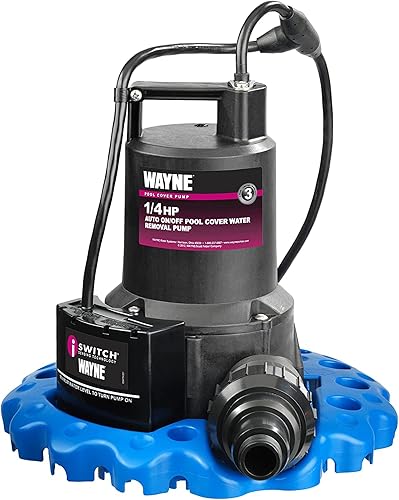 Best for balanced cover maintenance
Wayne WAPC250 Automatic Pool Cover Pump
8.8/10 our score
See it on Amazon -
2
 Best for a familiar hose setup
1/4 HP 2950 GPH Automatic Cover Pump
8.1/10 our score
See it on Amazon -
3

- 4
 Check it
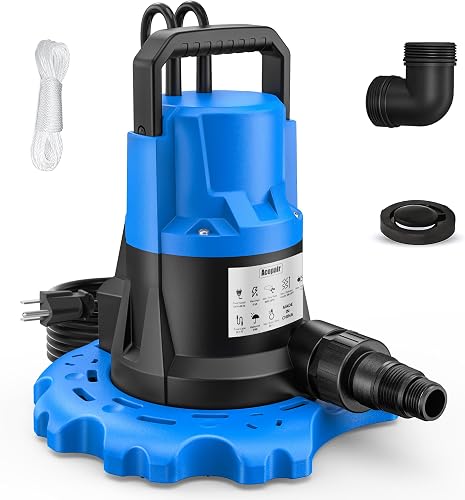
1 HP 5000 GPH Automatic Cover Pump
Best for a stated 5,000 GPH flow - 5
 Check it
AgiiMan 1 HP Automatic Pool Cover Pump
Best for shallow-water activation - 6
 Check it
Superior Pump 92395 Pool Cover Pump
Best for a simpler flow rating - 7
 Check it
3/4 HP 3400 GPH Automatic Cover Pump
Best for a removable strainer base - 8
 Check it
1/2 HP 2169 GPH Automatic Cover Pump
Best for a low suction level
How we chose pool cover pumps for inground pools
We compared the stated flow, automatic start and stop levels, suction depth, lift, cord reach and included connections. A pump that removes water automatically and fits the drainage route can be more useful than a higher flow rating alone.
Our score weighs specs and features against what you're shopping for: removing collected water from an inground pool cover.
Use the pool cover pumps category guide to compare pump types and related solutions. Before choosing a cover pump, it's also helpful to understand which pool cover type fits your pool.
| Product | Best for | Maximum flow | Automatic start | Power cord | Our score |
|---|---|---|---|---|---|
| Wayne WAPC250 Automatic Pool Cover Pump | balanced cover maintenance | 3,000 GPH with 1 1/4 in drain hose | At or above 2 1/8 in | 25 ft | 8.8 |
| 1/4 HP 2950 GPH Automatic Cover Pump | a familiar hose setup | Up to 2,950 GPH | At 2 in | 25 ft | 8.1 |
| Aquastrong 3/4 HP Automatic Cover Pump | higher lift needs | 2.28 in primary trigger | 8.0 | ||
| 1 HP 5000 GPH Automatic Cover Pump | a stated 5,000 GPH flow | Above 2.17 in | 25 ft | 7.9 | |
| AgiiMan 1 HP Automatic Pool Cover Pump | shallow-water activation | 5/8 in | 7.8 | ||
| Superior Pump 92395 Pool Cover Pump | a simpler flow rating | Up to 2,100 GPH | 7.6 | ||
| 3/4 HP 3400 GPH Automatic Cover Pump | a removable strainer base | About 2.7 in | 26.2 ft | 7.5 | |
| 1/2 HP 2169 GPH Automatic Cover Pump | a low suction level | 2.1 in | 7.3 |
The best pool cover pumps for inground pools
The Wayne WAPC250 ranks first for its mix of automatic controls and practical accessories. The other picks suit specific priorities, including shallow-water activation, stated flow or a removable base.
Wayne WAPC250 Automatic Pool Cover Pump: Best for balanced cover maintenance
- Automatic on at 2 1/8 in
- Automatic off at 3/4 in
- Maximum flow 3,000 GPH with 1 1/4 in hose
- 25 ft power cord and pull-to-shore rope
- Strainer base and check valve
Automatic start and stop, a debris strainer, a check valve and a positioning rope make this a balanced choice for routine cover water removal.
Pros
- Automatic on and off
- Strainer base helps screen debris
- Includes check valve and positioning rope
Cons
- Water below 2 1/8 in won't trigger automatic start
- Must be stored indoors when temperatures drop below freezing
The Wayne WAPC250 is the best balanced choice for a typical inground pool cover. Its iSwitch turns on at or above 2 1/8 in of water and switches off at or below 3/4 in.
Wayne rates its maximum flow at 3,000 GPH when used with a 1 1/4 in drain hose. The strainer base helps filter debris and keep the pump from tipping, while the check valve helps reduce repetitive cycling.
A 25 ft power cord and a separate 25 ft pull-to-shore rope give you room to position it over a cover. Wayne says its freeze protection circuit can shut the pump down if debris or ice locks the impeller, but the instructions still say to remove it from service and store it indoors below freezing.
Choose it for regular cover maintenance where its start level works for your pool. If water stays below 2 1/8 in, manual activation is needed.
1/4 HP 2950 GPH Automatic Cover Pump: Best for a familiar hose setup
- Automatic start at 2 in
- Runs 60 seconds after reaching about 2/5 in
- Bottom suction removes water to 3/4 in
- 25 ft power cord
- Check valve adapter
This Acquaer pump pairs automatic operation with a 25 ft cord and garden-hose adapter, making it a straightforward fit for many home setups.
Pros
- Starts automatically at 2 in
- Bottom suction reaches 3/4 in
- Includes check valve adapter
Cons
- Stops after draining to about 2/5 in
- Flow and product-style descriptions differ
The Acquaer suits buyers who want automatic operation with a common garden-hose connection. It starts when water reaches 2 in, then continues for 60 seconds after the level falls to about 2/5 in.
Its bottom-suction design is stated to remove water down to 3/4 in. The strainer base is designed to protect the cover, filter debris and keep the pump stable.
A 25 ft, three-prong power cord and a 3/4 in garden-hose adapter with check valve are included. The stated capacity is up to 2,950 GPH, though the product information also uses different horsepower and flow descriptions, so confirm the exact model details before ordering.
This is a practical fit when the 2 in start depth matches your cover's usual water buildup. Consider another pick if leaving less water behind is your main concern.
Aquastrong 3/4 HP Automatic Cover Pump: Best for higher lift needs
- 3,487 GPH stated flow rate
- Maximum lift 29.53 ft
- Bottom suction to 1/4 in
- Primary and secondary automatic triggers
- Freeze and thermal protection
Its stated flow rate and maximum lift suit covers where water needs to travel farther to reach the discharge point.
Pros
- Bottom suction removes water to 1/4 in
- Secondary automatic trigger
- Includes several discharge adapters
Cons
- At 13.7 lb, it is heavier than some options
- Requires placement in water before plugging in
The Aquastrong is suited to buyers who need a higher stated lift and multiple hose options. Its flow rate is listed as 3,487 GPH, with a maximum lift of 29.53 ft.
It uses a primary automatic trigger at 2.28 in and a secondary trigger at 2.87 in if the first one fails. The pump continues for 20 seconds after the water drops to 0.91 in, and its bottom suction design is stated to remove water down to 1/4 in.
The pump includes a garden-hose adapter with check valve as well as other discharge adapters. It weighs about 13.7 lb, so plan how you'll place and retrieve it; the instructions say to put it in the water before plugging it in.
Pick this option when the discharge route needs more lift or you want the stated shallow suction level. Its broader range of adapters is useful only if they match your setup.
1 HP 5000 GPH Automatic Cover Pump: Best for a stated 5,000 GPH flow
- Up to 5,000 GPH stated flow
- Automatic start above 2.17 in
- Shuts off below 3/4 in after 30 seconds
- Bottom suction design
- Multiple adapters
The Acopair's stated 5,000 GPH capacity is the highest here, for buyers who prioritize a high published flow rate.
Pros
- Highest stated flow in this group
- Automatic on and off
- Includes several adapter sizes
Cons
- Bottom suction reaches 3/4 in
- Warranty is 1 year
The Acopair stands out for its stated 5,000 GPH maximum flow. Its automatic sensor starts above 2.17 in and shuts off below 3/4 in after a 30-second run.
The bottom-suction design is stated to remove water down to 3/4 in. Several adapters are included for different discharge connections, and the pump has a 25 ft power cord.
The 1 HP rating and high flow figure make it a candidate for buyers focused on moving more water. Actual flow can depend on lift and discharge setup, so check that the hose and route suit the pump before deciding.
Choose this model if its stated flow capacity matters more than clearing the shallowest water. Acopair provides a 1-year warranty.
AgiiMan 1 HP Automatic Pool Cover Pump: Best for shallow-water activation
- Automatic activation at 5/8 in
- Shuts off at 1/3 in
- Bottom suction to 1 mm
- 36 ft maximum head
- 33 ft cord
Its stated start and suction levels suit buyers focused on clearing shallow water from a cover.
Pros
- Lowest stated automatic start level here
- Bottom suction to 1 mm
- Includes three adapters and a check valve
Cons
- Flow rate is below some higher-capacity picks
- Cord length differs between product bullets and included-components details
The AgiiMan is a fit for covers where water can be shallow before you want the pump to start. It activates at 5/8 in, shuts off at 1/3 in and is stated to suction water down to 1 mm.
The listed maximum head is 36 ft, and the stated flow rate is 3,500 GPH. Its product details give conflicting cord lengths: one bullet says 33 ft, while the included-components details say 10 ft, so confirm cord reach before buying.
It includes three adapters and a check valve, and its thermal controller is described as shutting down the pump if it overheats. The low activation level is the main reason to consider it over a higher-flow pick.
Choose it if shallow-water activation is your priority and you can verify the cord length for your placement.
Superior Pump 92395 Pool Cover Pump: Best for a simpler flow rating
- Up to 2,100 GPH
- Activates in about 1 1/2 in of water
- 25 ft maximum lift
- 115 V
This Superior Pump has a lower stated flow than the leading picks and a simple activation-depth description for buyers comparing basic needs.
Pros
- Automatic operation
- Stated maximum lift of 25 ft
- 115 V power
Cons
- Lowest stated flow in this group
- Included details do not specify a cord length or hose adapter
The Superior Pump 92395 is a simpler option with a stated capacity of up to 2,100 GPH. It activates in about 1 1/2 in of water.
Its maximum lift is 25 ft, and it runs on 115 V power. The available product details don't specify a cord length or hose adapter, so check those connections against your poolside outlet and discharge route before choosing it.
This pick has a lower stated flow than the pumps above it, but its activation depth is clear and its stated lift may suit a shorter drainage path. It may fit buyers who don't need the highest capacity or most accessories.
Choose it when those basic figures fit your setup and you can confirm the connection details.
3/4 HP 3400 GPH Automatic Cover Pump: Best for a removable strainer base
- Up to 3,400 GPH at zero lift
- Starts at about 2.7 in
- Stops at about 0.4 in after 20 seconds
- Removable strainer base
- 26.2 ft cord
The FLUENTPOWER's removable base and sensor-controlled start and stop offer flexibility for cover placement and drainage.
Pros
- Removable strainer base
- Check valve helps limit backflow
- 26.2 ft power cord
Cons
- Stated flow is at zero lift and falls with restrictions
- Starts at about 2.7 in
The FLUENTPOWER is a useful option if you want a removable strainer base. The broad base helps support the pump on a soft cover and screen larger debris, and it can be removed for clean-water drainage where a smaller footprint is useful.
Its sensor starts at about 2.7 in and keeps pumping for 20 seconds after reaching about 0.4 in. The stated maximum flow is 3,400 GPH at zero lift, with flow decreasing as lift, hose length and discharge restrictions increase.
A 26.2 ft cord, check valve and adapter options are included. Thermal overload protection helps manage overheating, but it does not mean the pump should run dry.
Consider it if the removable base suits your placement needs. Its higher start level may be less suitable when shallow buildup is common.
1/2 HP 2169 GPH Automatic Cover Pump: Best for a low suction level
- Automatic start at 2.1 in
- Stops below 0.4 in
- Bottom suction to 1/4 in
- 26.6 ft maximum lift
- 25 ft cord
The Vidapool combines automatic operation with a stated 1/4 in suction level and a 25 ft cord.
Pros
- Bottom suction to 1/4 in
- Automatic on and off
- Includes a check valve
Cons
- Lower stated flow than the leading picks
- Requires placement in water before plugging in
The Vidapool combines automatic operation with a stated bottom-suction level of 1/4 in. It starts at 2.1 in and turns off once the water falls below 0.4 in.
The stated flow rate is 2,250 GPH, and the maximum lift is 26.6 ft. It includes a 25 ft power cord and a check valve, with a discharge connection compatible with standard 3/4 in garden hoses.
The product instructions say to place the pump in water before plugging it in. Its combination of shallow suction and moderate stated flow gives buyers a middle option between the basic-capacity pick and the highest-flow pumps.
Choose it if the 1/4 in suction level and hose setup match your needs. Look elsewhere if your priority is a faster stated flow.
What should you compare before choosing a pump?
Compare start depth, shutoff depth, lift and hose connections before focusing on horsepower. Those details determine whether a pump will start when water collects and move it to a suitable discharge point.
A higher GPH figure is not a promise of the same flow in every setup. Lift, hose length and discharge restrictions can reduce flow, so account for the route from the cover to the drain.
Check the cord length against the distance to a suitable outlet, and keep electrical connections dry. Use a GFCI outlet where required by the manufacturer's instructions, and follow the pump manual for setup and safe operation.
Which pump suits shallow cover water?
The AgiiMan has the lowest stated automatic start depth in this group at 5/8 in. The Wayne starts at 2 1/8 in, while the Acopair begins at 2 in.
Start depth and suction depth are different. Start depth tells you when automatic operation begins, while suction depth describes how low the pump is stated to remove water after it runs.
If your cover holds only a thin layer, compare both figures. Also consider whether the pump's shutoff setting leaves an amount of water you're comfortable managing.
How do hose connections and lift affect the choice?
Match the pump's included adapters to your hose and discharge route before buying. A check valve can help limit water returning through the hose when pumping stops, but it doesn't make every hose connection compatible.
Maximum lift matters when the water must travel upward to reach its outlet. The Aquastrong lists a maximum lift of 29.53 ft, while the Superior Pump lists 25 ft and the AgiiMan lists 36 ft.
Those figures do not guarantee the same flow at the maximum lift. For an accurate match, consider hose length, hose diameter, bends and where the water will drain.
What should you do if a cover pump stops working?
First check whether the water is deep enough to trigger automatic operation, then inspect the intake and hose for blockage or kinks. Unplug the pump before clearing debris or moving it.
A pump may not start when water is below its activation depth. For step-by-step checks, read pool cover pump not working: what to check first.
Follow the manual for any reset, freeze or dry-run protection procedure. Never handle a plugged-in pump in water, and use a properly protected outdoor outlet.
Which inground pool cover pump should you choose?
Choose the Wayne WAPC250 for balanced automatic operation, debris screening and included positioning accessories. Pick the AgiiMan if shallow-water activation matters most, or the Acopair if you want the highest stated flow in this group.
Before deciding, match the pump's start and suction levels to the water your cover typically holds. Then confirm its cord, hose connection and lift suit your poolside layout.
If you're still choosing a cover style, see our guide to best inground pool covers for winter.
Our top 3 picks at a glance
-
1
Best for balanced cover maintenance
Wayne WAPC250 Automatic Pool Cover Pump
8.8/10 our score
See it on Amazon -
2
Best for a familiar hose setup
1/4 HP 2950 GPH Automatic Cover Pump
8.1/10 our score
See it on Amazon -
3
Frequently asked questions
What size pump do I need for an inground pool cover?
Choose a pump by how quickly water collects, how far it must travel to drain, and how much water remains after it shuts off. A 2,950 GPH pump may suit routine buildup, while a higher stated flow can appeal when you prioritize faster removal.
Flow ratings can fall with lift, hose length and discharge restrictions.
Can a cover pump sit directly on a pool cover?
Use the pump's base and follow its instructions for placement on the cover. A broad strainer base can help support a pump on a soft surface and screen debris.
Keep the intake clear, and use a rope to position or retrieve a pump when one is included.
How much water should a pool cover pump leave behind?
That depends on its suction design and shutoff level. The picks here state remaining-water levels from 1 mm or 1/4 in to 3/4 in, while automatic start levels vary from 5/8 in to about 2.7 in.
The cover's slope and shape can affect where water gathers.
Can a pool cover pump run in freezing weather?
Don't assume a pump can keep running through a freeze. Wayne says to remove the WAPC250 from service when temperatures drop below freezing and store it indoors to protect it from ice damage.
Check each pump's instructions for its own cold-weather limits.


